

Every switch, sensor, and relay in a control panel does one job. It turns a circuit on or off at the right moment. But not every device does this job the same way: Dry contact vs wet contact.
Engineers split this behavior into two categories: wet contacts and dry contacts. This guide explains both terms. You will also read a real case study from a Texas water plant showing why this distinction matters.
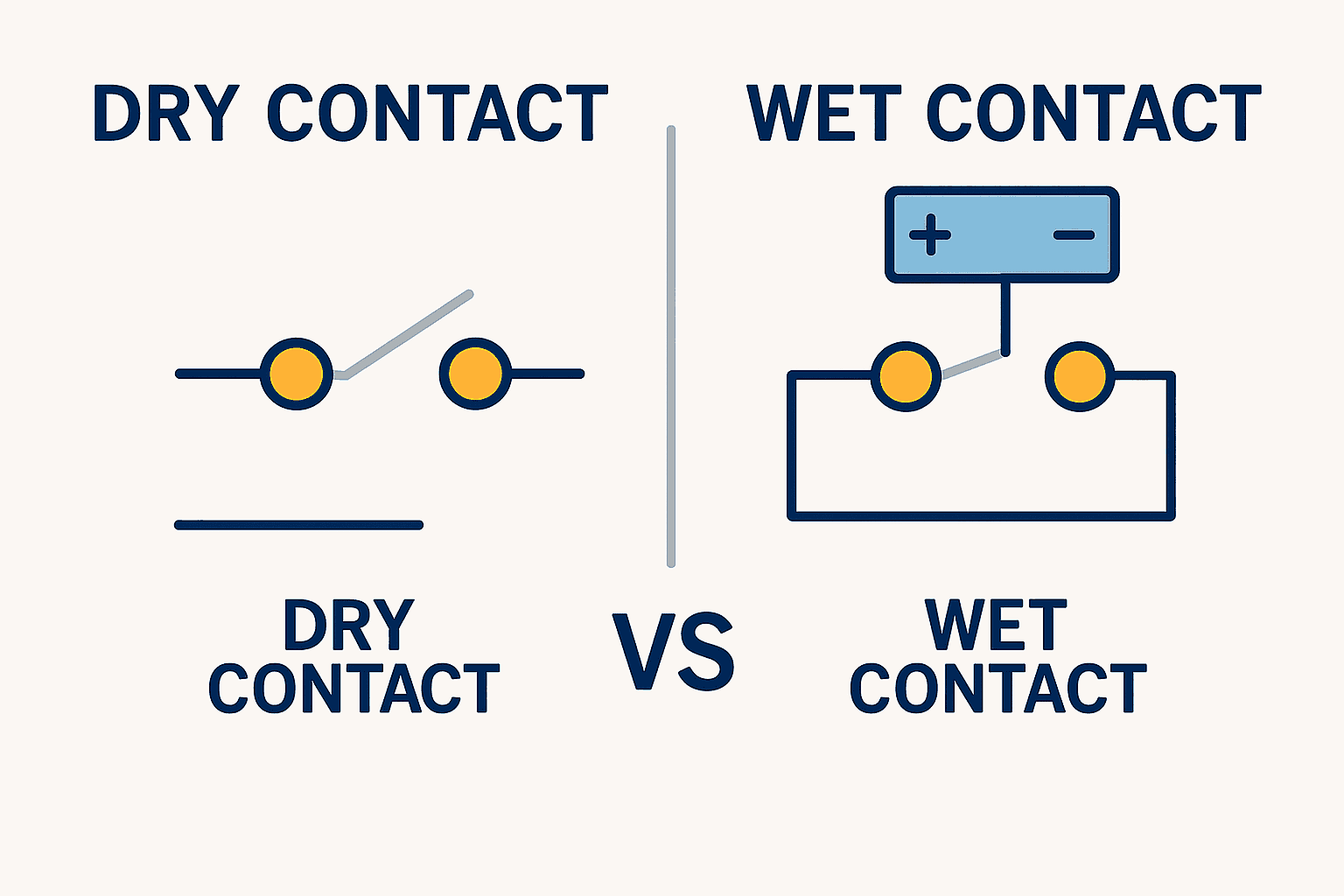
What Is a Dry Contact?
A dry contact carries no voltage of its own. Technicians also call it a “voltage-free” contact or a “potential-free” contact.
The contact only opens and closes a path. Power for the load must come from a separate, external source through a common wire.
Relay terminals labeled common, normally open, and normally closed all describe dry contact wiring. PLC output modules almost always follow this same pattern, needing an IN or COM terminal for every output group.
What Is a Wet Contact?
A wet contact already carries voltage at its terminals. The moment the contact closes, that same voltage flows straight to the load.
No separate common wire runs to the device. The power that energizes the sensor is the same power sent out to the connected circuit.
Proximity sensors and many solid-state switches work this way. Once the sensor gets power, its switching action pushes that exact voltage onward to whatever it drives.
The Core Difference in One Line
Dry contact: it is just a switch. No power runs through it. You bring your own power wire to make it useful.
Wet contact: it already has power inside it. Close the switch, and that same power comes right out the other side.
Why Relays Almost Use Dry Contacts
Every relay, including solid-state relay models, relies on dry contacts. This design choice gives one big advantage.
A relay coil might run on 24V, yet its contacts can switch a completely different voltage for the load. A wet contact cannot do this. Its output voltage always matches its input voltage.
Isolation: The Other Reason Dry Contacts Win
Control panels often need input and output circuits kept fully separate. Surges of hundreds or even thousands of volts can hit a circuit during a fault.
Dry contacts protect the rest of the system from these surges. This is exactly why optoisolators and isolation relays are built only as dry contact devices.
Where Wet Contacts Make Sense
Not every application needs isolation. Small sensor circuits feeding a PLC often skip it on purpose.
Here, the sensor and the load run on identical voltage levels. Power draw stays minimal. Wiring gets simpler because one wire both powers the sensor and carries its signal back to the controller.
A Familiar Wet Contact Example: The GFI Circuit
Ground fault interrupters use this same wet contact logic internally. The wires that power the GFI’s internal circuitry are the same wires that power its output terminals.
There is no separate isolated path inside a standard GFI. Input and output share the same live wiring, just like any other wet contact device.
One Rule That Applies to Both Dry contact vs wet contact
This entire wet-versus-dry discussion only applies to discrete, on-off devices. Analog devices that output a variable voltage or current do not fit into either category.
An analog sensor never uses a simple set of contacts. It sends a continuously changing signal instead. Keep this distinction in mind when reading any wiring diagram.
Real Case Study: A Water Treatment Plant in Texas, USA
A water treatment plant near Houston upgraded its pump control system in 2019. The engineer needed the pump’s alarm output linked to a remote SCADA monitoring station.
The old pump controller shipped with a wet contact output. Its 24V DC supply powered the alarm signal directly at the terminal block.
The new SCADA input card expected a dry contact only. This card design accepted a simple open-or-closed switch signal, nothing more.
A contractor connected the wet contact wire straight into this dry-contact-only input. He skipped checking the datasheet first. Full 24V DC hit a card built for a voltage-free signal.
The input card failed within two hours. Three pump stations lost visibility on the SCADA system during a period of critical water pressure monitoring.
How the Plant Solved the Problem
A senior engineer added an interposing relay between the two devices. This relay accepted the wet contact’s 24V signal safely.
The relay’s own dry contact output then connected onward to the SCADA card. This step kept the live voltage completely away from the sensitive input circuit.
Total repair cost stayed under fifty US dollars for relay hardware. The plant had already lost close to twelve hours of remote monitoring data before the fix went in.
Lessons Every Technician Should Take from This
Check the datasheet before wiring any output terminal. A wet contact and a dry contact can look identical on a wiring diagram, yet they behave completely differently in the field.
Add an isolation relay whenever a wet contact device must feed equipment designed only for dry contact signals. This single component prevents burned-out boards and expensive downtime.
Label every terminal clearly during panel assembly. Mislabeled terminals cause most of the wiring mistakes seen in real installations.
Dry and Wet Contact Devices in Home Automation
Homeowners across India and Pakistan increasingly install DIY smart security panels. Door sensors and motion detectors get wired without checking their contact type first.
A dry contact door sensor draws its power from the smart hub itself, usually 12V or 24V. A wet contact sensor already has its own battery built inside the housing.
Mixing these two types inside one home security panel leads to false alarms or total sensor failure. This mistake shows up often in budget smart home kits sold across South Asia.
Dry Contacts in Oil and Gas Sector
Saudi Arabia’s oil and gas facilities depend heavily on dry contact relays for emergency shutdown systems. Safety engineers prefer this design in hazardous zones for a clear reason.
A dry contact carries no live voltage across its open gap. This lowers the risk of a spark igniting nearby gas or vapor.
Wet contacts still appear in non-hazardous control rooms, where the isolation requirement matters less.
Testing a Contact with a Multimeter
Set the multimeter to resistance or continuity mode first. Never start with voltage mode on an unknown contact.
Touch both probes to the contact terminals. A true dry contact reads zero voltage even while closed.
Switch to DC or AC voltage mode next. A wet contact shows a measurable voltage reading immediately, even before any load connects.
This entire check takes under a minute. Every field technician should run it before wiring any new relay or sensor into a panel.
Dry Contact vs Wet Contact in PLC Wiring
PLC digital input cards commonly expect dry contact signals only. Feeding a wet contact’s live voltage into a card rated for a voltage-free signal damages the input circuitry fast.
Most PLC cards accept 24V DC maximum on their dry contact inputs. Always place a relay interface module between a wet contact field device and any PLC input card built for dry signals only.
Cost Differences Worth Knowing
Dry contact wiring needs an extra power wire run out to the field device. This adds material and labor costs on longer cable runs.
Wet contact wiring saves this extra wire since the device already carries its own voltage outward. Large plants in Pakistan often pick wet contact devices for this reason on long-distance installations.
Smaller commercial panels across the USA still favor dry contacts. Standardized safety practices and easier isolation make this the safer long-term choice.
Frequently Asked Questions
Is a relay contact wet or dry? A relay’s switching contact is dry. Only the coil needs its own power; the contact itself stays voltage-free unless a separate design adds power to it.
Can a dry contact handle AC power? Yes. A dry contact can switch either AC or DC power supplied from an external source within its rated current limit.
Why do fire alarm panels rely on dry contacts? Different buildings run different voltage systems. A dry contact output stays compatible with whatever external voltage a fire alarm circuit uses.
What happens after reversing wet and dry contact wiring? Reversing these connections often destroys relays, sensors, or PLC input cards. A wet contact’s live voltage overloads a circuit meant to sense a simple switch closure only.
Final Thoughts
The terms “dry contact vs wet contact” sound minor, yet a single wiring mistake can silence a critical monitoring system for hours. The Texas pump station case proves this clearly.
Engineers and technicians across the USA, India, Pakistan, and Saudi Arabia face this exact decision on nearly every panel build. Knowing the difference protects equipment, safety, and budget alike.
Read every datasheet before wiring. Test every contact with a multimeter first. This one habit prevents costly failures on any electrical project.